MAGIC
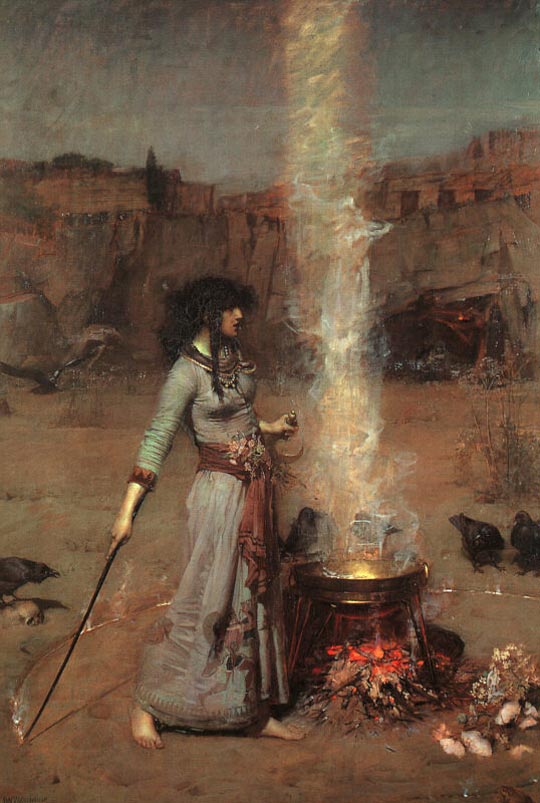
It is fortunate that we have two sides to our brains, for in some of us each side leads a largely independent existence. My left hemisphere abhors religion and superstition. I most definitely don’t believe in God, gods, the devil, witches, ghosts or vampires. In fact I am quite evangelical in my atheism. My right hemisphere however, continues to churn out poetry with a strong magical and spiritual content. I can only hope that the paradox of an atheistic shaman creates artistic tension. There is in my poetry a belief in the magic of words. Not all words of course, but only the old words. The English language has an interesting history. It was originally a Germanic language which subsequently borrowed many thousands of Latin and French words. Somehow these borrowings still seem strangers and would be inappropriate in a spell. One poem was actually written as a curse. The feelings that inspired it were very real and very powerful. Curses only work if the person cursed believes that they will work, so just in case this poem might cause harm to the credulous, I have included a little antidote, a curse-lifting poem. There is a blessing here as well which was actually used to try and bring better climatic luck to a house plagued by storm and flood. Mostly though, the magic of words is being used in an attempt to defeat time. Many of the old European fairy stories have the defeat of time as their theme and I have felt free at times to allude to them.
Some years ago my wife, Gillian and I went into partnership with another couple, Prue and Volker L. We bought a large piece of regenerating bush. Our mutual aim was to restore the bush, although for a time we kept cattle in the clearings. Gillian and I worked hard for two years restoring an old villa we had had moved onto the property. When it was just about finished, our partners declared that they were no longer willing to share with us. The trouble was probably that Prue's family had once owned the property and her sense of proprietorship overcame her sense of fairness and friendship. We could not afford to buy them out, but they could afford to buy us out. We were very angry and very sad. "Makutu" is the Maori word for "curse" and the following poem was written and pronounced as a very real curse. Whenever it is read now, I feel that the antidote to the curse that follows it should also be read.
Makutu
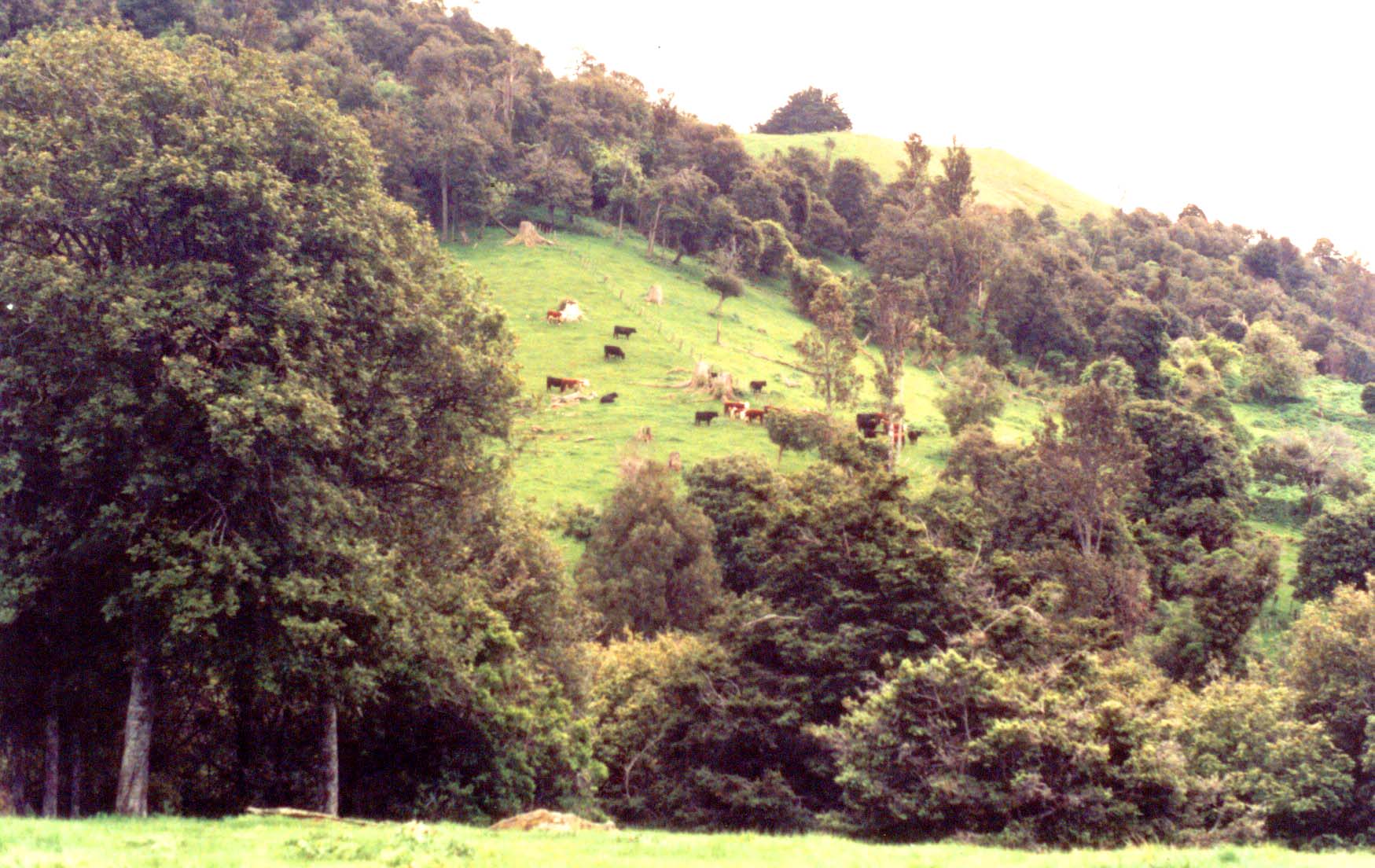
How do you curse a warm valley
nestled among bush-clad hills?
You curse the clammy crevice
sweating between mountain thighs.
May the land be barren and your womb dry.
May all springs fail and cattle die.
May fantail and kereru perish
and only thrush survive.
Let possums gnaw the ngaio’s bones
then die in gutters and watertanks.
Let magpies skewer all fledgling chicks
and strip the flesh from newborn lambs.
Let the variegated thistles
grow horse and rider high
and liberate a snow of seeds
to settle in each crack of the parched soil.
Let the wild brambles tempt each sheep
with fresh green leaves and sweet
to snare them in a tangling noose
and starve them in their tethered reach.
Let the hungry ewes eat watercress
in the snail infested creek
so that their livers crawl with flukes
and they founder with sodden wool
as food for the koura and eels.
May grass grubs impoverish the pasture
And may it be a blowfly summer
when stricken lambs twitch their tails
as the maggots burrow into their flesh.
And when the drought is done
let it rain not gently upon the land,
no soft forgiving drizzle fall,
but a downpour to launch an ark,
to block all culverts and scour all paths,
to waterlog the clay soil.
Hungry cattle will pug it to a quagmire.
Let the hills creep and the soil slump.
Watch the creek run brown as the land bleeds.
Prospero
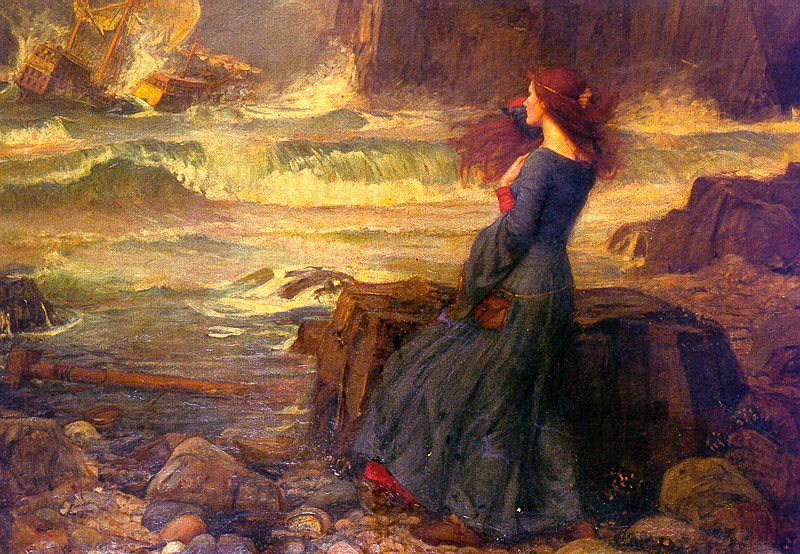
The curse is lifted, the shade shifted
That trees might grow and stock prosper.
I, Prospero, do ban, ban Ca-caliban
From the isle, let Ariel go
And fair winds blow
To make Miranda smile.
I let go,
I surrender my right to utu.
No more makutu.
I am the mender, the godsender,
The make-amender.
I am sated and requited.
All wrongs are righted.
All curse revoked and null and void
To avoid divine retribution,
The wrath of gods.
No more at odds.
Even stevened, levied and leavened,
Restored to heaven,
Quits.
The following is of course a quartet of sonnets.
The Four Elements.

Earth
The secret bed, the rich red earth.
Warm as blood in the spring sun.
A heaving, seething mass of life.
The basic, sordid source of birth.
Dirt under my nails, honest toil.
The dignity, the worth of work.
The pungency, the sweat and smell.
The harrowing of the soul in soil.
A handful blest of fertile loam
In the open grave we throw
When we each in earth inter,
Return the earthborn to their home.
Inoculate against all woe,
The terra incognita below.
Air
Unfilled fetal lungs cleaved like glue.A whispering zephyr kissed
Us on infant lips. Our first
Great gulp of eager air we drew.
Filled with spirit, new inspired,
We soared on eagle’s wings,
To the world’s four quarters flew
To all our beating hearts desired.
My thoughts as thistledown disperse
Wafting on the winds of heaven.
To reach my stratosphere
I write ethereal verse.
I cast off in the blowing gale
As Aeolus fills my billowing sail.
Fire
I saw in viper infra-redThe corona of your body heat.
Your aura warm betrayed you
Though shielded by your skin of lead.
Choked with envy, stoked with ire,
I wore no furnace on my face.
You could only guess I yearned,
And burned with white hot fire.
And now as dully glowing ember
Will I flash super nova bright,
The swansong of a dying sun,
As I my radiance remember?
In the black hole of eternity
Will I be singularity?
Water
We were with holy water blest,Bedewed, with eau de vie imbued,
Infants in fonts baptized.
Launched on life’s long quest.
From the blue iris of our eyes
Welled up the waters of our tears,
As salty as the ancient seas
That saw all forms of life arise.
Water that washes, purifies,
Restores the untrodden sand,
Brings the freshness of beginnings
And rainbows in our evening skies.
Show me, the modern Argonaut,
The golden fleece I ever sought.
"Waikuia" is Maori for "Old Woman's Water", which you may interpret as you may. It was the name given to a friend's house. Barbara F. asked me to write a blessing for her house because it seemed terribly prone to storm and flood damage. This poem was recited at the four corners of the property.
Blessing for Waikuia
I all natural shades invoke,
All ancient fey and faerie folk,
To bless this nest, this home and hearth,
To charm from harm this pale and garth.
No evil stay ‘neath eave or gable.
All nightmares now must leave this stable.
All blessings flow and all be hallow.
Fertile flower both field and fallow.
May no hail fall on fell or hollow.
Keep all who dwell here safe from sorrow.
No lightning strike nor awful thunder.
May no winds tear this home asunder.
Only the old words will cast a spell,
Ward and guard from foul and fell;
Fend your yard with lock and chain;
Keep your home from bale and bane.
Words of power will fence you tight
From ghastly terrors of the night;
Words that need no staff or wand
To banish evil back beyond.
This house will thrive with hex and ward,
All nature grow in sweet accord.
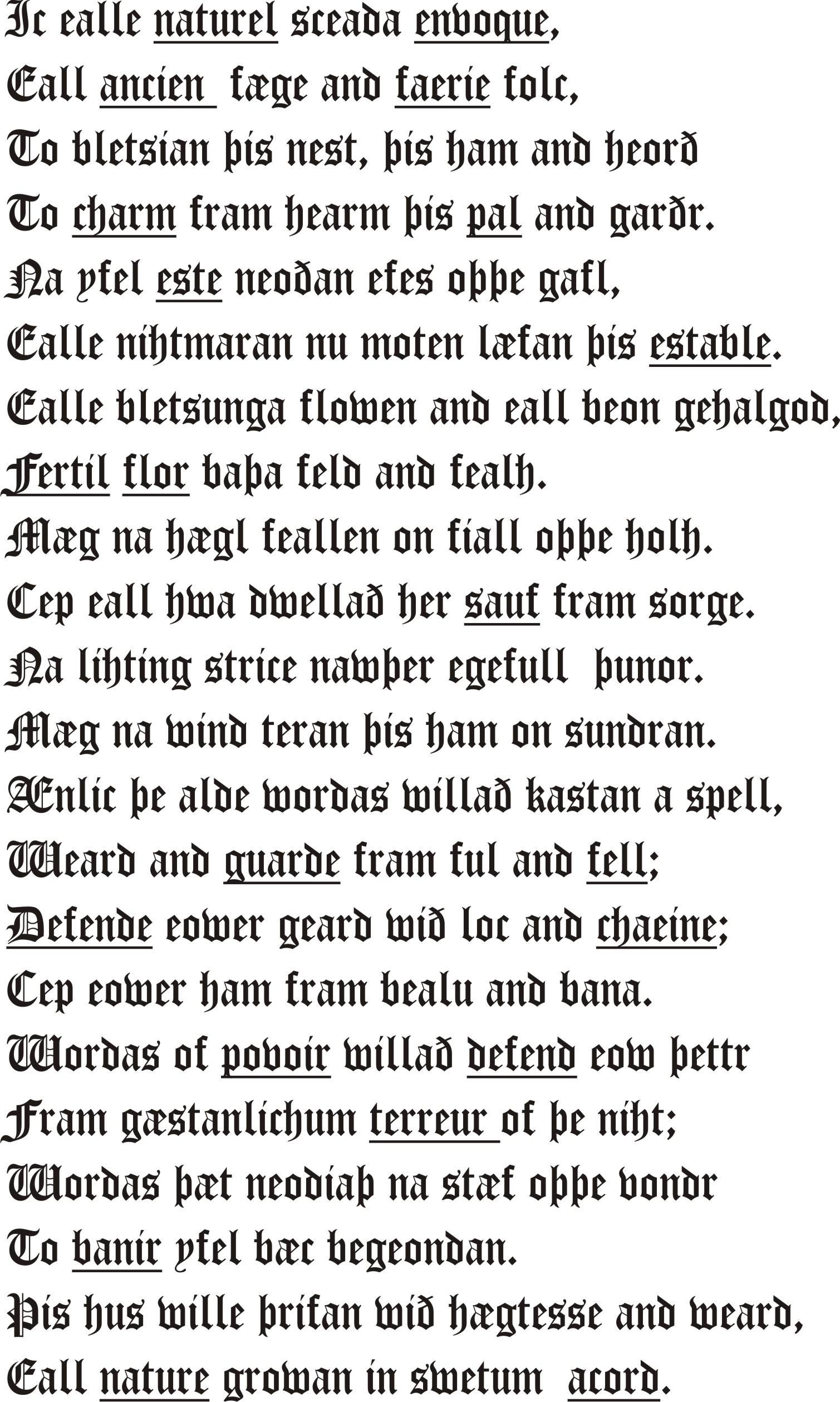
The above poem was also an exercise in trying to use the highest percentage of Old English words possible. You could regard it as an Old English charm. You will see how close it is to Old English by comparing it with my Old English translation below. The underlined words are not Germanic - all the rest are either Old English or Old Norse.
Sleeping Beauty
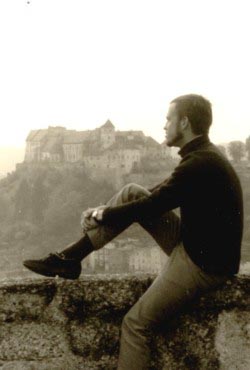
Little Rosethorn lay by charm embalmed,
Her beauty May morning dewtime fresh,
Spared all corruption of the flesh,
In the lonely lake of time becalmed.
Her lover scans the distant castle wall,
Bushlawyer, bramblewire entwined.
He can no entry to her alcove find,
Yet forever held by spell in thrall.
Cruel thorns embedded in his skin
Encyst as callouses for fifty years,
But one migrating in his heart appears.
One small prick, his world in widderspin.
He leaps tall walls at a single bound,
Cuts Gordian knot and Gorgon’s hair,
Prises Fenrir’s jaws apart to tear
Persephone from the underground.
He sets a gentle kiss on Rosethorn’s brow.
A glow suffuses her cheek at last.
As her eyes open she looks aghast
To see his ravaged leering visage now.
The following poem was written after we attended the wedding of Stephen G., the son of my friend, Quentin, to Laura D., the daughter of my friend, Jenny. It was held in a grove of redwood trees at Havelock North on Te Mata Peak.
Redwood Wedding
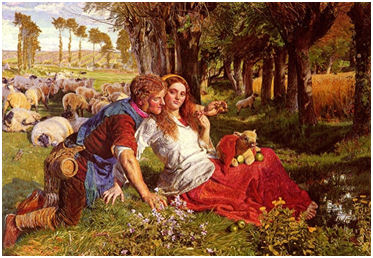
Bearded patriarchs and shirt-sleeved men
With muscled farrier arms
And sturdy ramrod backs.
Girls in swirls of skirts, hibiscus
And bougainvillea bright.
Women in light draped frocks
That follow curve of haunch and hip
And twirl in spun glass of petal pink,
Or tendril curl in gossamer vines
Or fretwork tracery of retted leaves.
Gender roles are clear, unequivocal.
We are satyrs or wood nymphs,
Druids of the spear side
Or dryads of the distaff side,
For this is a wedding rite
In a grove of giant redwood trees
Under a sultry high-summer sun.
The bride and groom plight troth
Beneath the sweeping boughs,
Braided like bridesmaids,
Plaited like the corn sheaves
Above the board of Breughel’s feast.
They recite their vows of love
As if the delight and dalliance
Of this, their wedding day,
Were all its purpose or significance.
A girl sits on a redwood root,
The folds of her lapping skirt
Breaking against the bole,
Arranged like bowerbird wings,
Forming a lap wherein some lover
Might rest his head. Cradles instead
Her guitar, and plectrum strums the strings
And in soft soprano sings.
A young man hums in baritone
His warm brown umber tones of song,
Baffled by the redwood bark,
Reverberate the sacred glade along.
This is contrapuntal male and female melody.
We feel the tribal urge in the air,
A well sprung wishing of fecundity,
A swelling surge among the throng
To grace the union of this man and wife
With ancient blessings of renewed life.
The next poem was inspired by something as close to real magic as one could imagine. A couple of your German backpackers were staying with us and an ad for the movie Changeling appeared on the tele. I asked them what the German for "changeling" was and they didn't know. I wandered over to my bookshelf and picked up my German English dictionary, but it didn't offer any help. Then I felt my eye being drawn to a dusty book on the top shelf and I pulled it down. It was a copy of the poems of Annette von Droste Huelshoff which I had either never read or perhaps had delved in some forty years ago. The book fell open at a certain page and I read before me these words: Findlinge nennt man sie, weil sie von der Brust der muetterlichen gerissen sind, in fremde Wiede, schlummernd, unbewusst, die fremde Hand sie legt's wie's Findelkind - o welch ein Waisenhaus ist diese Heide. A rough translation would be: They call them foundlings, because they are ripped from the maternal bosom. The stranger's hand lays them as orphans slumbering and unaware in a strange cradle. Oh what an orphanage is this heath. Now is that, or is that not utterly spooky? Who guided my eye, who guided my hand, who chose the page? Was it the ghost of the long dead poetess telling me something. I must check if she was an orphan. What a lovely German word even if it does sound like a Jewish pianist. Perhaps I am a changeling! Perhaps I am a transsexual re-incarnation of the dead Annette!
What a delicious idea for a poem.
Findelkind
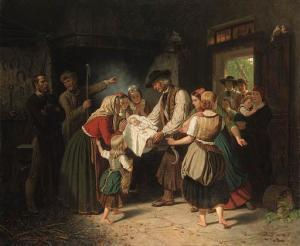
Topped and tailed in the one bed
the other sturdy children clasped their ears
against their mother's labour screams.
No midwife came through the dark night.
no knock at the door, no-one witness bore.
Imago, nymph, changeling child,
red-faced uakari monkey cub,
more incubus than cherub.
With his wizened face and wise eyes
he saw how best to parasitize.
Some say he was a doorstep brat
left by a whore in a launderette
or wrapped in a shawl of Brussels lace.
Some say he was born in a lacy caul
with a shock of white lanugo fur.
He grew a shy, introverted soul,
not like his sturdy, jovial kin.
But they still suckled and sustained him.
loved, fed and clad their cuckoo chick,
the fosterling with ever open beak.
Until he shamed them with things unsaid:
the poverty of their language,
his interest in philosophy,
his musical virtuosity,
their profound inadequacy.
And yet his warbler parents gave no hint
they had raised in vain a findelkind.
He would one day hunch his shoulders
and tip all memory of their love
over the guano gunwale of his nest.
As a teenager he was already convinced,
As he was cauled so was he called
by such an auspicious omen
to some remarkable career,
some life of true significance.
Perhaps he was Goethe personified,
reliving the sorrows of young Werther;
perhaps he was destined to be
a transsexual reincarnation
of a noble German poetess.
As the years progressed, nothing came,
no conflagration from that first bright flame.
The humdrum mundane wore him down
to a shade of grey obscurity.
As candle guttered, at last he uttered:
I have served now my time on earth;
I have deserved; I am truly worth.
I have endured my mortal stint.
Now worn, transparent, frail,
Come and reclaim your findelkind.
Next