MAORI POETRY
Having taught at two schools in Hawkes Bay New Zealand which are predominantly Maori, it is not surprising that I have acquired a number of Maori words en passant or that I have incorporated some Maori themes into my poetry.
Driving To Te Aute

Across the backblocks to Te Aute
In the long drought of an El Niño summer.
Dry grass, dead grass, no grass, burnt soil.
Thin sheep look hungrily as I pass.
But the gnarled ngaios are still alive.
The titoki trees are fresh and green.
The trees are old and have long long roots
That reach deep down into the bedrock
Where the ancient aquifer flows.
But look with slow-motion gaze upon the scene
And see the faint white cross on every tree.
The skull and crossbones where the white limestone
Outcrops from the dry hillside.
Each leaf unfolds and each tree looks in horror
At the black spot – the mark of death.
There are no saplings, no seedlings, no mokopuna.
The thin sheep wait for every shoot to sprout.
The Thin sheep wait for every seed to fall.
The flecks of green marring the perfect brown
Are isolated and exposed, picked off one by one.
To the farmer all looks unchanged
Much as it was ten years ago
Or when his father felled the totara
To make fence-posts for the farm,
That are now lichen-covered
And loose-socketed in the ground
Like an old woman’s teeth.
Fast forward the film and see the flecks
Flick out of existence, flicker and fade.
See the spreading stain and shrinking green.
Hear the trees cry. See the land die.
Phantom Canoe
The Tarawera Eruption » Rotorua Museum - Art | Culture | Heritage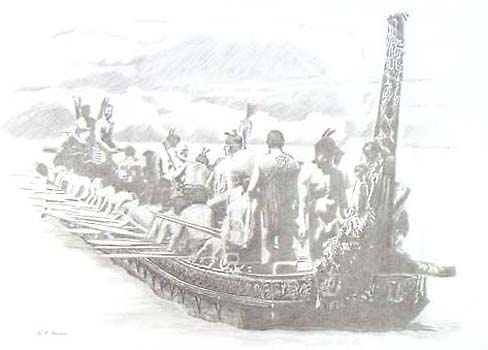
Lake Tarawera, warm and mysterious
With bubbles rising like champagne,
In endless chains from aqualungs.
The whiff of overcooked eggs
And fish that occasionally floated
Belly up like sacrificial offerings.
The doomed lake that brooded in the shade
Of Tarawera, the domed mountain.
Mists formed always on cold mornings
As the cool breeze met the warm water.
Yet people went about their business,
The Maori in their low sod huts.
The white men in their bungalows.
The tourists came in crinolines
Bonnets, buttoned boots and parasols.
In deer-stalker hats and plus-fours,
Baedeckers and shooting-sticks.
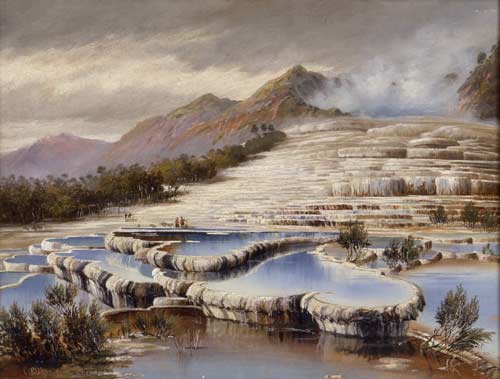
To view the Pink and White Terraces,
The great silica staircases,
Eighth wonder of the natural world.
Sophie, the guide, bit on her pipe stem,
Spat and gazed out into the rising mist.
From afar she dimly heard voices
In a rhythmic native paddling chant.
Rité, ko te rité! Rité, ko te rité!
Tiaia, a tiaia. Toki hika toki!
All together, all together now.
Plunge the carved paddles in, heave away.
Plunge, pull, lift, breathe! Plunge, pull, lift, breathe!
A waka-taua, the great war canoe of the Maori,
Surged and emerged from the shrouding mist
With the flash of a hundred paddles
Breaking the water in unison.
Warriors bare-chested, brawny armed,
Each with a top-knot coiled and oiled,
Wearing two white-tipped feathers
Of the huia now long extinct.
Each with the blue, chiseled spirals
Of the moko, full facial tattoo.
Amidships stood a stout, squat man,
The kai-hautu, keeper of the beat,
Belly roll swaying as he swung his taiaha,
His quarter-staff of totara wood
In time to the paddle chant he led.
And aft by the soaring stern post
Carved with the claws of the manaia,
And the fern frond coil of the koru,
Stood an impressive muscled warrior,
Clad in a dog-skin cloak and holding
The greenstone club of an Ariki,
A warrior chief of the Maori.
“Taringa whakarongo! – Listen ears!”
He impelled the assent of silence.
“Hikitia! – Lift up!” and every man
Raised his paddle clear of the water.
“Pakia! – Strike!” and every warrior
Slapped the wet paddle with his hand.
A synchronous clap like a rifle shot
Roused water fowl from the reeds,
Rattled the windows of the wooden hotel.
As Sophie, the native guide, watched,
The canoe disappeared back into the fog.
A waka-taua, a war canoe,
On peaceful Tarawera lake
Where none had sailed for fifty years.
When the mists lifted the lake was empty
And lay preternaturally still
While the herons settled back to their roosts
And the locals to their morning chores.
In the small hours of the next night
While the tourists slept on their linen sheets
And the Maoris on their mattress of fern
And the ducks with bills still tucked under wing,
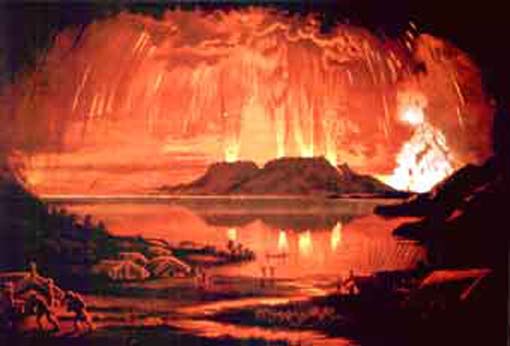
Mount Tarawera blew itself apart.
Hot ash and lava bombs rained down.
The hotel was soon a gutted ruin.
The day dawned black as deepest night,
Lit only by lightning and lava glow.
Lake Tarawera yawned and swallowed
Forever the famous tourist terraces,
And some say for the sin of sacrilege
Buried each surrounding Maori village.
My Maori Kids
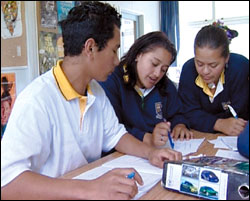
The Maori kids call me Mistah.
What do we have to do Mistah?
“You must’ve mucked about
When I was telling you what to do.
You no risten. You must’ve missed the
Boat when brains were given out.
You are the archetypal exponent
Of attention deficit syndrome.”
Yet I say none of these things,
But stay P.C. and calm and explain again.
These children are demanding and loud.
They seek attention and love.
They can be friendly, but beware
They can be obnoxious brats
Or even devil spawn newly hatched.
Some girls are juvenile obese,
Sugar junkies growing ever more globular.
My rubbish bin is a spittoon to their habit.
They copy out screeds on diabetes
And the glycaemic load of lollies,
But still they chew and masticate.
Other girls are pretty with a hard edge,
Nice enough if you disregard the nose-rings,
Lip studs, red Mongrel Mob t-shirts
Showing beneath their uniform.
Nice enough until you catch
The whiff of stale cigarettes.
Nice enough until offended
When they can make the air moko blue,
Spit tacks, slam doors and storm out
Like a she cat scalded.
The boys are less complicated,
Mischievous little rascals,
Vicious little villains
Full of prejudice and hate.
Their shoes are down at heel.
Their socks unwashed are full of holes
Bearing mute witness to the death
Of the noble art of darning.
Some smell of honest playground sweat
And some of stale and one of urine.
Some have unwashed greasy locks;
Some have shaven skulls.
They vandalize their books with swastikas,
Steel helms and bulldogs,
Insignia of a master race.
Many of these children are illiterate,
Some pathetically so,
Desperately craving help.
Some frustrated and angry,
Breaking pens and chairs
And other children’s faces.
These are broken souls
Coming to school
With the scars of their childhood.
But we cannot turn back time,
Cannot rebirth them,
Cannot rewrite their childhood history.
Matariki
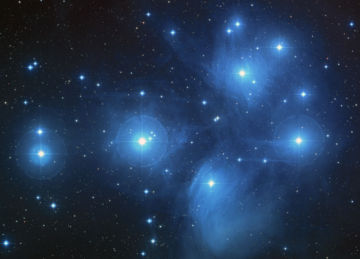
Tiny eyes peeping through the dark curtains - Matariki,
The shy brown eyes of the star children – tamariki.
Eyes of wonder, eyes of innocence.
There is a new year, bright as a butterfly,
Moist and soft from its chrysalis.
Watch but do not touch as it inflates and unfolds
Its shining perfect wings.
Look up and find the Pleiades,
Catch the shy glances of Matariki,
And you too will be bathed in beginnings,
Washed in the new year’s light.
Forget the darkness you have seen.
You are perfect in the eyes of children.
Te Aute Artroom
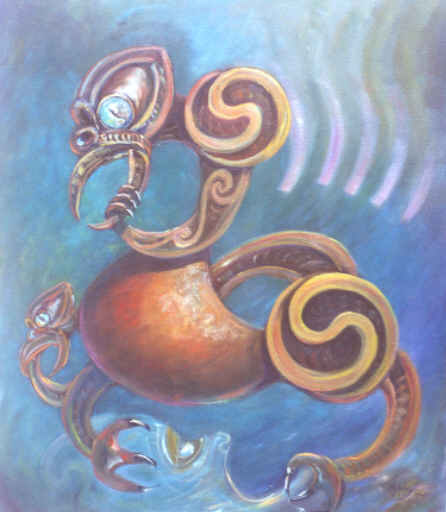
A fantail flies through the open door
Of the artroom at Te Aute,
Piwakawaka under eaves
To swoop among the taniwha,
To perch on the rafters
At home among the kowhaiwhai.
It darts down in pirouette
To snatch flies from the windowpane,
To nod and bow and flick its fan
In utter confidence of man,
To swoop around and loop de loop,
To twitter merrily and leave at will.
Then a stray sparrow wanders in,
Panics, and bashes its head
Against the unseen glass.
All around hawk-eyed paua stares,
Talon of manaia tears.
What is this voodoo bric-a-brac,
Clay nguru and wooden tiki,
Carved bone and twisted flax,
This shaman’s cave, this totem trap?
The sparrow flies full tilt
Into a tukituki panel
And breaks its neck.
Te Onepu Hill
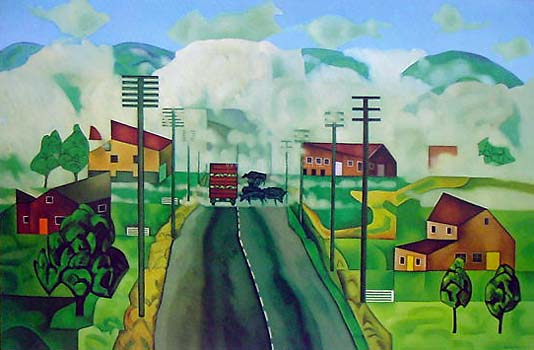
I crest the wave of morning to te Aute
Into the eye of the sun over te Onepu Hill
And look down at the valley of Pukehou
Brimful of shining cloud from shore to shore.
A bowl of quicksilver sparkles in the sun.
Hilltops rise like islands in the icy sea,
Emeralds in a silver crown,
An ocean of fluffy eiderdown.
I see cattle stand starkly on the shore
Where cloud breakers crash silently.
All is still, muffled in cottonwool.
All is pure, sheeted in clean silk.
All is innocence, bathed in milk.
I drive down into the sea of cloud
And the windscreen is smeared, vision blurred.
The engine’s roar shatters the peace.
The diesel exhaust pollutes the mist.
I break through into a netherworld
Of cattletrucks and traffic noise,
A cacophony of blaring sound,
The discord of the underground.
Tiki Wananga
Elephants feel with their noses
And hear through the soles of their feet
The distant rumblings of ultra sound,
The crooning of a mother to her calf,
The defiant tusker trumpet call,
As he is shot by poachers for his ivory.
The door to my classroom
Is stopped by a prosaic piece of wood,
Two foot six by four by two,
The colour of sun bleached bone.
It might prevent burglary
By half hearted weekend louts.
Years later the herd on trek stumbles
Across the tusker’s scattered bones,
Picked clean by hyenas and vultures,
Gnawed by porcupines.
Reverently they caress each shard,
Lift skyward the winged scapulae,
Nudge gently shins and shanks,
Blow dust through eye sockets
And adore each orb and orifice.
Long ago our distant ancestors,
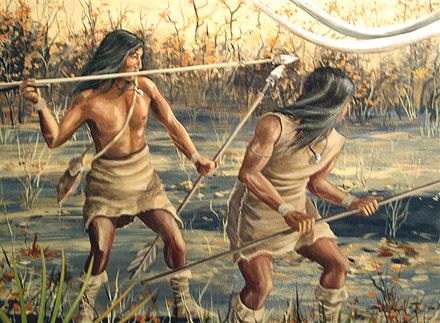
Mammoth hunters of Eurasian steppes,
Carved Aurignacian hunting scenes,
Magic scrimshaw runes on tusks,
Clan totems of bison and elk.
They buried each hunter with ochre
Under a giant shoulder blade.
In my classroom the Maori boys
Are fascinated by the piece of wood.
Each adores it kinaesthetically,
Inscribes his tag in black vivid.
They scrutinize the stick for emblems
Of their mates, for blood signs,
For taboo totems of their clan.
My doorstop has become a Rosetta Stone.
It is a scratching pole for tigers.
It is scent marked with the spraint of wolves.
Maybe on this tiki wananga
They can smell their ancestors,
Hear echoes from their tipuna,
Feel the footsteps from their distant past,
Rumbling in ultra sound.
Next